RSS

Tag Archives: Opinion

The Worst Idea I EVER Had…

So what’s the worse idea you’ve ever had? Did you actually follow through with it? Well, I had a bad one, and I followed through with it, and it stunk!

For years I’ve tried to find the right “diet” for me and my family. I always tried to weigh the health benefits of what we ate and since I am the cook in the house, it falls primarily on my shoulders. Plus, being a doctor, my wife tends to go with what I say on nutrition since I “should” know best right?

Physicians receive about as much training in med school on nutrition as my 6 year old got about the Ming Dynasty in Kindergarten. We learn all kinds of things in and around the physiology of the human body, including the complex interaction between insulin, fat, and weight. We learn the details that is, but nothing that is the least practical in day to day life. As an internist your primary goal in training is to learn to keep people alive, but mainly when they are ACUTELY dying. Ho hum day to day primary care is covered, but not as well as more serious hospital care. So what we learn falls in line with the standard “calories in-calories out” teaching that I of coarse now reject. We learn about protein, carbs, and fat, and how fat contains twice as many calories as proteins and carbs, so they must be what make you fat!

It’s important for everyone to know that their doctors (most likely) preach this information because that is the little that they were taught, and it’s hard enough to keep up to date with all the new information when it comes to everyday practice. New drugs, new clinical trials; they all take precedent most of the time over relearning old topics. Especially when the “data” that has always been emphasized falls in line with the above train of thought. How can fat not make you fat? It just doesn’t make sense if you stick to the knowledge we are presented in our training.

So, how did I end up putting the time in to learning about Paleo? Well, that goes back to my big mistake! Around 4 years ago I read a book called the China Study just around the time my daughter was turning 2 years old. I was bound and determined to live a healthy life, avoid the chronic diseases my patients lived with everyday, and I knew my diet was the key. So, I became a Vegan. For a year…yes, a year. I bought all kinds of new cookbooks, swore bacon back to the fithly swine it came from, and became one with tofu. I’m nauseated just thinking about it.

I told everyone around me I was going to try it for a year and then re-evaluate. I knew two months in I should just quit, but I’m too darn stubborn to not go the whole year. I…FELT…TERRIBLE all the time. I was hungry, cranky, slept terribly, missed food, and even gained a little weight to boot. As a veggie all I did was try to find ways to make things taste like meat. Tempah, faux chicken stock…and the worst idea ever TO-freaking-FURKY. For the record, I never ate Tofurky, but the thought crossed my mind. It was obvious I craved meat, I was gaining weight, and I felt exhausted all the time. Come to think of it, how often do you run into a fit and energetic looking vegan? I will confess to all here, I did not make it a full year. Around 6 days before the year mark my wife and I were visiting friends in Manhattan and we booked reservations to a wonderful place called Del Frisco’s Double Eagle Steakhouse on 6th Avenue. The original Del Frisco’s is in Fort Worth,Tx, and we have been there many times. I ordered the biggest New York Strip on the menu and sat in awe as the blazing hot dry aged beef fat burst into my mouth on first bit. Meat was back, thank goodness!

I kind of gave up trying to even figure out what is best to eat. I stopped cooking as much, gave in to the kids desires to turn into a miniature chicken nugget, and took the easy way out for a year or more. Eventually I started cooking again, but never with much purpose other than to make tasty things. Now I can cook, and it was fun throwing together tons of classics, mastering homemade gnocchi, building a wood burning pizza oven, making artisan bread at home…all the foodie things you can think of! Still, my wife and I were just living. We didnt’ feel good, we didn’t feel bad; we didnt’ gain weight, we didn’t lose weight…you get the picture.

Around a year and a half ago our neighbor’s started eating Paleo. My initial thought was no way, I’m not trying another fad diet because they don’t work. Why give so much up for so little gain. So we just kept up with the status quo. In the fall of last year my wife was outside talking to our neighbor, and when she came in she said “I think we should go Paleo.” Secretly I was dying to do SOMETHING, I just hated feeling defeated and controlled by food. In typical fashion in our house, we decided I would read the book, and I would give her the short version in less than 10 minutes!

I bought Robb Wolf’s book on my iPad Kindle app, and away I went. I read the whole thing by the end of the weekend and I got energized in a way I have never been before. Why? Rob MADE SENSE, and he included all the science and data my medical mind needed. If you have not read his book, please do so you know why Paleo is important and correct. He gives you the option to skip the “why” of Paleo and just read the “how.” I urge you not to do this as I feel strongly that if you know why you will be more motivated to stay with it. That night I downloaded Why We Get Fat by Gary Taubes and I polished it off in two days (long nights rather). How could I change my mind so fast? This was completely against all I had been taught.

The reason is simple, my patients. I see patients all the time who come in, either have not lost weight, gained weight, or are the same; take your pick. All the while they swear they are counting calories, trying hard, and exercising where they can. I hear this story countless times a day. So there are two options: they are either all complete bold faced LIARS!, or what they are doing is not working. With Paleo, I found the answer… It’s not working.

From that day I have been very strict in my Paleo eating, and have eaten as clean as possible. Have I been perfect?; no I have not. But I can honestly say I have been 95% compliant in my eating and as you all know I am 13 days into my Whole 30 at the moment. My personal results are all the “data” I need to change the way I talk to my patients. I feel good, have lost 25 pounds or more without trying, I am NEVER hungry anymore, and I sleep like a log. Most importantly like I have mentioned on other posts, I am finally in control of my diet. Food no longer controls me and that is the most rewarding part of my journey. Will this lifestyle fizzle out in me? Guess you should never say never, but I just don’t know how I could ever go back to eating non-Paleo. Even now when I “cheat” there are certain absolute no-no’s like wheat, dairy, and soy.

All this has led to this blog, and I have plans for more Paleo projects in the future. I am a very lonely voice in the world of Internal Medicine when it comes to Paleo, but there are many years to come. I am not convinced that the government will, republican or democrat, ever change their views on nutrition and flip the food pyramid over the way it should be. It’s just so sticky, complicated, and political; but that should not stop me or all of you from trying to help others. Over the next few months I will be laying out several projects aimed at bringing Paleo more into the conversation in mainstream medicine. I’m most excited about an observational trial I am hoping to start soon with the help of the Hartwig’s over at Whole 9 Life looking at Paleolithic Nutrition in Diabetics. Exciting things to come!

I am most amazed by the quality, passion, and intelligence of the leaders of the Paleo community. This is not a fad movement, but rather a well educated, scientifically based, and compassionate group of people who want to help people get healthier with simple food choices. I humbly add myself to the mix in hopes of adding to the knowledge base and hopefully…changing the course of history. Together we can do it!

If you are a Vegan out of choice, or a vegetarian for religious reasons I certainly understand. I am simply sharing my experiences and personal frustrations in my life. Medically, I do have questions about how healthy a meat-free diet is, just as I have questions about the health of people following a traditional “heart-healthy” low fat diet. Thanks

-E
 
9 Comments

Posted by on May 19, 2012 in General Paleo Discussion


Tags: ,

Statin Drugs, Inflammation, and Paleo: My Take

I tweeted a link to a study today about the use of Statin cholesterol drugs in essentially any patient over the age of 50, and how routine use in these patients significantly lowered their risk for a significant cardiovascular event (heart attack or stroke).  Now before you just dismiss this as another example of how big pharma is trying to take over the world, let me tell you why you need to pay attention to this study.

First of all it’s big…like 175,000 people big.  In the world of clinical studies, that’s a very impressive number.  The more patients take part in a clinical trial the more powerful it is in general.  This study took 175K people and showed that even in patients with a very LOW risk for heart disease, statin drugs improved their risk of events significantly.  Is this surprising?  Not at all!

Several years ago the so called JUPITER trial looked at the ability of statin drugs to lower what is called highly sensitive CRP (hsCRP).  Studies have shown a very nice correlation between hsCRP levels and short term risk of heart attack.  Levels below 1 are good, between 2-3 are moderate risk, and between 4-10 are high risk for badness.  This trial took 18,000 patients with low LDL (bad cholesterol) and no cardiac risk factors and put them on statins vs. placebo.  The results were so beneficial for the statin group that the study was called off early to allow the placebo group the chance to take a statin.  The marker used to track benefit was a consistent drop in hsCRP in the statin group.

So what does that mean?  CRP is what we call a marker of inflammation.  A regular CRP measures levels of inflammation throughout the entire body, while hsCRP was developed specifically to look at inflammation in the cardiovascular system.  So if we can lower the hsCRP it means that we are lowering the inflammation in the cardiovascular system (easiest way to look at it).  In turn, if statins lower hsCRP, then they must have anti-inflammatory activity right?

That is absolutely right.  It has always been known that statin drugs have a kind of two tiered mechanism of action.  The significant improvement we see in cardiovascular risk seen in patient’s taking statins is too great to be coming only from a simple drop in the patient’s cholesterol.  Statins go into the inflamed walls of diseased arteries and block inflammation.  They are what we call “Plaque Stabilizers.”  Heart attacks and strokes occur when an artery wall is inflamed and swollen with inflammatory markers and cholesterol.  A plaque can be “stable” when it is relatively dense, or “unstable” when it is fluffy and chock full of inflammation and fat.  One little irritation in the cap of an unstable plaque leads to a lighting fast inflammatory response and acute blockage of the artery with a clot.  Anything downstream does not get oxygen; if its heart tissue you get a heart attack, if it’s brain you get a stroke.  So statins without doubt lower your risk of heart attack by lowering your cholesterol, as well as lowering the inflammation in your arterial walls.  This is essentially fact.

Another action statins have on the inflammatory cascade of heart disease is that they counteract the known inflammatory effects of Omega-6 fatty acids.  In our world where the fat pendulum has swung almost completely to the Omega-6 (over Omega-3) side of the aisle, there is no surprise that statins help so much.  Again, this is essentially fact.

The mistake that was made many years ago was in believing that statins purely lowered heart disease risk by lowering blood cholesterol levels.  Linear thinking led to the belief that lowering dietary cholesterol and fat MUST in turn lower heart disease risk as well.  Good idea, just not the right idea!  Statins REALLY work through their anti-inflammatory properties to lower cardiovascular risk, but we didn’t figure that out till later!  Easy mistake to make, but now that we know the rest of the story, we need to go back and correct our thinking.  Unfortunately that is proving more difficult than many of us would like.

One other thing to discuss is side effects of these medicines.  I am completely amazed at the generalized fear and misrepresentation of the side effects of statin drugs.  They have clear and known potential risks, particularly concerning the liver and with generalized muscle weakness.  That being said, I can say in my clinical experience these drugs are generally very well tolerated and safe.  I have been prescribing statins for near 11 years in both training and private practice, and I know of one definitive case of rhabodomyolosis (life threatening muscle breakdown) and only a handful of cases involving significant (but fully reversible) liver inflammation from the drugs.  Are statins for everyone? No.  Are they the most dangerous drugs in the world that should be pulled off the market?  Absolutely not.  They are safe, and they work.

So, what am I saying?  Does everyone need to be on a statin?  Well, if we don’t change our dietary ways as a society the answer may be yes!  In my humble opinion there is a better way of course!  Say for example we significantly curtail wheat in our diet, as well as any other similar proteins that can cause generalized inflammation in our bodies.   This should in theory lower our overall CRP levels, and likely our hsCRP levels as well.  In addition, what if we concentrated on changing the fatty acid profile of our foods to shift the Omega-3:Omega-6 ratio back to the side of Omega-3s.  This would be like turning back the hands of time in our food supply to a time when corn, soy, and wheat did not dominate our agriculture.  We know (fact) that Omega-3 fatty acids are not atherogenic so we would easily lower our cardiovascular risks as a whole.  With these two actions as a society we would accomplish the same thing as giving everyone a statin.  Amazing huh?

The problem is that these changes would be very hard to bring around.  It is easy for us to sit on our Paleo high-horses and state the obvious, but it will be a real battle.  A fundamental change in the way we raise our protein in America and around the world will be a daunting task.  Finding ways to affordably feed the world’s population without a dependence on extremely cheap wheat based products will take years of work.  It is not easy, but I feel it must be done.

I hope this helps you think twice next time you see a headline about the benefits of a drug.  Before you spout off some diatribe about the evils of big pharma, look closely at what it’s all about.  Are statins overused?…according to this study they should be used more!  And, we likely WILL use them more.  That being said Statins work, they are safe, and most interestingly they teach us a great deal about inflammation, heart disease, and why our beloved Paleo lifestyle works.

I hope this all made sense to everyone.  If you have any questions leave a comment or feel free to tweet me at @PaleolithicMD.

In the end…it’s ALL about inflammation!

-E

 
16 Comments

Posted by on May 16, 2012 in General Paleo Discussion


Tags: , , ,

What I Think Makes Paleo Different…Control

In my practice I see tons of patients every week, and a large majority of them need to lose weight to become healthier overall.  Most of them are aware of this, they do not want to be overweight, and have often tried various diet plans over the years without success.  Through the course of our normal conversation about their health I typically hear lots of things like…

–> I just don’t know why I can’t lose weight, I don’t eat that much…

–> I did pretty good on diet “X”, but after a good start I stopped losing weight…

–> I’ve been doing really well, I only splurge a couple of times a week…

–> I just need to exercise more and I’ll lose weight…

There is a disconnect between the desires of what and how much they want to eat, and how much weight they want to lose to be healthier.  I hear things like “I want to lose weight, but I can’t give up my two cokes a day.”  The challenge is to help them see the disconnect in their thinking.  It’s not easy…

I’ll admit, there are some patients I feel useless doing so with, but at some point I have to decide to introduce the Paleo diet as an option to them, and then fight their pre-conceived notions about the dangers of fat and cholesterol.  Most see a cardiologist, and they have been preached to about for years about the low fat, high carbohydrate diet that is most “heart-healthy” for them.  One of our local heart doctors is a firm believer in a vegan diet for his patients.  Most hear what he has to say and say there is no way they can follow it.  They basically reside themselves to the fact that they will not lose weight, and that their next heart attack or stroke will happen inevitably.  This is the backdrop against which I get to approach my patients with about Paleo!  The story changes to…

–> It’s too expensive to eat that way…

–> What exactly do you eat if you can’t eat bread and rice…

–> I need calcium for my bones so I have to eat dairy…

–> I don’t eat red meat because it’s bad for me…

Ultimately what I have to do is prove to my patients that Paleo is different, that it WILL work for them.  Over time I’ve developed a few a strategies for talking with patients about this, so let’s go over a few.

A common response to hearing the restrictions (as seen by patients) of Paleo is to proclaim what they cannot live without!  I can’t live without bread, sweet tea, rice, gravy, potatoes, among others.  Some will defend their “healthy” food choices stating that yogurt is good for them, and they need milk for calcium (especially since they drink 2% milk!).  What about whole wheat pasta, EVERYBODY says it’s good for you right?!

So I carefully debunk all these misconceptions and present this scenario.  Take rice for instance.  I ask them “If a doctor came in the room today, and told you that if you ever eat rice again, you will die 30 days after, no questions.  Guaranteed death if you touch even a grain again.  Would you eat it again?”  The answer is (almost) always no!, “I would not eat it again if I was going to die”.  So, they just proved without a doubt that they could in fact live without rice.  Simple…check please.

Next is the concept of how RADICAL this lifestyle is.  They simply can’t imagine life without their favorite things.  I explain to them that it seemed that way to me as well when I first heard of it, but that the more I looked into it, the more sense it made to me.  I challenged myself to do it for 30 days and re-evaluate at that time.  I have not looked back for one second because of how many positive changes I saw in my health and life.  So I simply challenge them to the same thing.  I ask them to give me 30 days to change their life.  Can they honestly not do something for just 30 days?!  It is key that they understand that not only do I believe this is best for them, but that I actually DO IT myself!  That is the biggest thing they need to hear.  At that point it’s simply up to them, can they do it for 30 days?

After all this, many patients are still skeptical, they want the “hook”.  They need for me to tell them something they can really relate too.  So what is it?  What to me makes Paleo different to me?

It’s all about control.  For the first time in my life I do not in any way, shape, or form feel the least bit controlled by food.  Cookies, cinnamon rolls, King Cakes (a Louisiana Mardi Gras Tradition), gumbo…whatever! can go in and out of my station at the office and I honestly don’t give them a second thought.  In traditional diets food always seemed to be in control.  Goodies would enter the office and my attention turned to them, and more specifically that I could not have them.  It was all about what I could NOT eat, what I felt I could NOT have, what I was consistently depriving myself of.  So how am I not depriving myself of bread? Or rice? Or whatever?  In truth I guess I am, but it doesn’t matter to me because I’m not hungry anymore.  When you eat a certain way and stop feeling hungry or craving things, it’s hard to feel deprived.

Once you make these simple changes in your diet, you in turn slow down the insulin train that makes you hungry at all times…even when you are not hungry, and your emotional tie with food changes.  What I find most associated with obesity in my patients is emotion, depression, isolation, boredom, poor self-esteem, poor relationships, etc.  When you cut the fuel to these triggers, which I consider to be the hunger carbohydrate based eaters experience, you begin to be set free of all these negative things.  Hunger is a pervasive reminder of everything you find bad about yourself.  Despite knowing it’s not good for them, carb eaters feel the only path to feeling better is to satiate their hunger.  Once they do they get upset about their actions, and the cycle starts to go round and round.  Low-fat, High Carb diets lead to hunger and energy conservation through inactivity, which in turn leads to weight gain.  Yep, these diets make you gain weight in the long run.

Enter Paleo.  You cut the carbs, cut the insulin, and cut the hunger that leads to weight gain.  Once you start to succeed, and are not constantly thinking about food, you can start to cut the cord between you and your crutch.  In a nut shell your life is not controlled by food.  Food becomes a means to an end…you want to live, and to live you have to fuel your body, and you fuel your body with food.  For years I spent a life dominated by food.  Vacations were all about where we were going to eat, I spent the day wondering what would be for dinner.  I would eat out of boredom, not even worrying if I was hungry or not.  Now that I’ve erased the hunger, I just don’t care as much anymore.  Don’t get me wrong, I still LOVE food!  I love to plan and cook meals for my family.  I can’t fully explain it…but I’m no longer controlled by food…I can finally ENJOY food!  Now I hear things from my patients like…

–> That sounds exactly like me, and I had given up hope I could change…

–> It’s worth a try because I don’t want to feel like this anymore…

–> I finally understand why I’ve failed over and over again losing weight…

Obese people don’t want to be obese.  They want to succeed.  Once they hear that Paleo can set them free of hunger…that they can take CONTROL of their lives again…I finally see a sparkle in their eye…

-E

 
6 Comments

Posted by on May 12, 2012 in Uncategorized


Tags: , ,

Can Going Paleo Help Your Sleep?

Being that I am a sleep doctor, one of the things that I found most curious about my transition to a Paleo diet is how much it seems to have improved my sleep. I was never necessarily a bad sleeper, but I find my sleep to be exceptional since my diet change. I fall asleep quickly, which I always have, but it’s the continuity of my sleep that has improved. In the past I would often toss and turn, waking up several times during the night for no particular reason. These days I fall asleep, and the next thing I know my alarm is going off and it’s morning. I feel more refreshed in the mornings and don’t feel the afternoon fatigue I used to have on occasion.

My wife has also noticed a difference. For almost two years she used Lunesta to help her fall asleep and she was tired of having to use it. It left her groggy in the mornings and she seemed to just drag all day. Without it she could not fall asleep easily so she used it out of necessity. Once she also committed 100% to a Paleo diet she began to sleep better. She got off the Lunesta and after a week or so of flushing it out of her system, she has been sleeping better than she has in over 10 years. She sleeps well, feels refreshed in the mornings, and has very infrequent awakenings throughout the night.

In almost all of my patients that have adapted their diet to the Paleolithic plan I have seen an improvement in sleep similar to our experience. So the question is why? Why does sleep, in particular sleep continuity seem to improve with a change in diet? I’ve searched the medical literature and have found no definitive studies to answer that question. So, I’m going to offer my OPINION on why this may be the case. Let’s look at a couple of things.

I discussed in a prior post that a fairly well timed hormonal dance occurs around the time we go to sleep. Cortisol nears its nadir at the time we normally fall asleep, and growth hormone is on the rise during this time. This exchange of hormone levels, along with an increase in our natural melatonin leads to us going to sleep. If these hormones are off for whatever reason, the result can be disjointed sleep. We know that cortisol and insulin are closely tied, so it makes perfect sense that by adapting a diet that lowers your overall insulin levels that will likely have a positive affect on your cortisol levels. Although maybe not completely understood, an interplay between insulin, cortisol, and growth hormone are involved in the improvements in sleep seen with Paleo.

Another area that affects sleep is your gastrointestinal system. When you eat a diet full of GI irritants, large meals are bound to affect how you feel. Your sleep is an ever changing state where you move between sleep stages freely throughout the night. Normally the changes in your sleep stages, or stage “shifts” are fairly well timed leading to a fairly small number of overall shifts though out the night. Anything that disrupts sleep such as Obstructive Sleep Apnea or Periodic Limb Movement Disorder does so by essentially increasing the number of stage shifts. This increase in shifts leads to a higher rate of arousal from sleep (aka waking up) and therefore less restful sleep. Any number of things can lead to stage shifts, including any pain or discomfort you may have. Chronic GI irritation from a traditional carb based diet leads to excessive gas, bloating, and cramping that I believe disrupts sleep quite a bit. You do not have to be completely conscious of your arousals, in fact you are not aware of most, but your brain recognizes them and you feel them in the morning as fatigue. I’m sure we all would agree that a Paleo lifestyle has led to much a much calmer GI system…to say it nicely. If we feel better in the day, we feel better at night, and we sleep better because of it as well.

Sleep is also very closely tied to one’s emotional well being. One of the most common signs of chronic depression is chronic insomnia. There are two basic forms of insomnia: sleep onset and sleep maintenance. As you may expect sleep onset insomnia is trouble falling asleep, and sleep maintenance is trouble staying asleep. A typical depressed sleep pattern is taking too long to fall asleep due to excessive thinking, and early morning awakening. This early morning awakening can be anywhere from 2-5 AM, and again is prolonged by what I call the “I can’s shut my brain off” syndrome. Once people wake up, they just can’t stop thinking enough about what they have to do or what has happened to them to fall back asleep. A gluten laden diet has been linked to depression in many studies, and many people report significant improvements in their underlying depression or hopelessness by changing to a gluten free diet. Paleo of course is gluten free and then some. It’s not hard to link a paleo diet with improved depression, and improved depression with improved sleep. When we treat depression with traditional antidepressants one of the first thing patients report is a dramatic improvement in sleep, particularly sleep maintenance. If you consider Paleo eating more of a natural antidepressant, then the improvements in sleep are easy to understand.

Lastly I think sleep is improved with the Paleo diet basically by association with other aspects of the so called Paleo “lifestyle”. When you decide to go Paleo, you normally do it with the basic intention of getting healthier and feeling better. To that end most do not stop only with their diet. Adapting a new lifestyle also includes increasing your physical activity and focusing on a more overall positive attitude. When you exercise you get tired, and getting more tired in the day leads to better sleep at night. Think of your kids; when they play hard or swim for hours they sleep like logs…we are the same!

Over the next few months, try to focus a little more on your sleep. See how certain things affect your sleep. In particular, notice how any “cheats” may affect your sleep. Some can be a little less compliant and get away with it, but many can’t. Gluten and dairy in particular can significantly affect your sleep, even in small doses.

One last thing, what if you are totally Paleo, and still can’t sleep? Paleo can make you sleep better, but it cannot treat or cure many sleep problems. Insomnia is not to be taken lightly, and can be a significant medical issue requiring sleeping pills to treat. From Restless Leg Syndrome to Delayed Sleep Phase Disorder, sleep disorders are real and are not always treatable “naturally.” Likewise, depression is a pervasive and life changing illness that often requires medication to manage. If you feel depressed despite a Paleo diet, or you can’t sleep, or both!, please do not feel “ashamed” or “weak” in any way by seeking appropriate care and treatment from a health professional. Don’t lose another night of sleep worrying about it.

-E

 
1 Comment

Posted by on May 9, 2012 in General Paleo Discussion


Tags: , ,

What Can Sleep Apnea Teach Us About Sleep Deprivation?

Around 25% of my medical practice is devoted to sleep related disorders.  Without question, the most common sleep disorder I diagnose is Obstructive Sleep Apnea (OSA) [Click HERE for a link to my guest blog article written for Dr. Samuel Bledsoe’s blog, Bariatric Freedom] Most believe insomnia would be the most common disorder, but that type of patient rarely visits my office.  Why you may ask?  Typically, because their family physician treats them with sleeping aids to band aid the problem, or they never complain because they do not recognize poor sleeping habits as a problem with a solution.

Americans do not value sleep.  I see it daily, and unfortunately I see the price my patient’s pay in their overall health.  The symptoms most commonly associated with poor sleep hygiene are daytime fatigue and poor work performance.   However, would it surprise you learn that inadequate amounts of sleep have also been linked to heart disease, high blood pressure, elevated insulin and thus blood sugar levels, worsening of asthma symptoms, and even death?  To learn why, look at one of the most common sleep problems, Obstructive Sleep Apnea.

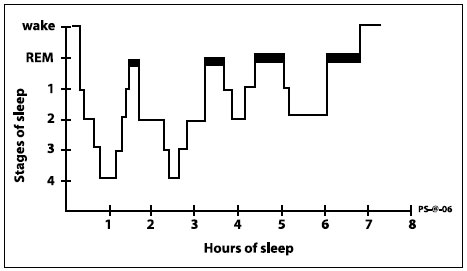
OSA is a condition where you have intermittent pauses in breathing (apneas) while you sleep.  As you cycle through sleep, typically, you move from the lighter phases of sleep (Stages I and II) into the deeper stages (Stage III and REM).  The graph below illustrates a fairly normal sleep cycle in a healthy young adult.  I might point out that recently state III and IV sleep were combined into once stage known as Delta sleep in the sleep medical literature, and the hypnogram below still has the old nomenclature.

When you have intermittent apneas at night, usually from your airway closing on itself, it leads to at least a 10 second pause in breathing.  As your oxygen goes down, your carbon dioxide goes up.  It is this carbon dioxide that eventually reaches a level which tells your brain that it is time to breathe!  The key is when you start to breath again, you almost always experience what we call an arousal.  This means your brain waves, or EEG, shows a shift to a lighter stage of sleep, usually all the way back to wake.  Just as quickly as you woke, you fall right back asleep, but at a lighter level.  Therefore, if you have moderate sleep apnea, you may stop breathing 30 times an hour, and thus wake up 30 times an hour!  Of these, you may actually be aware of only once that you wake, but your brain is aware of each and every time.

What is the result of this very intermittent and choppy sleep?  Symptoms!  Classic symptoms of sleep apnea include feeling sleep deprived upon waking, morning headaches, drowsiness while driving, mental fogginess in the morning, fatigue, sexual dysfunction, and getting busted snoring in public places.  An analogy I tell patients is to imagine you slept 8 hours overnight; however, during this sleep period you were awakened every 30 seconds, then you immediately fell back asleep.  Obviously, you will not feel refreshed!  This is a life with sleep apnea.

It is important to note that you do NOT have to be overweight, or even snore to have sleep apnea!  Sleep apnea is caused by a narrow upper airway that has an abnormal tendency to close when relaxed.  If your airway has this propensity, you are at risk of developing OSA.  If you are at risk and gain too much weight, your chances increase dramatically.  Therefore, obesity makes OSA worse, but does not necessarily cause it.  Yes, I do diagnose 115 pound, 35 year old females with severe sleep apnea.  If you have these symptoms and they are unexplained, see a certified sleep physician.  Do not solely rely on how you feel.  Let me say that again, having sleep apnea is not necessarily related to poor life choices.  Like many disorders, you can inherit the tendency to have problems that can lead to poor health.

So, what does this have to do with anything you ask?  Let me just lay out a few of the hormonal changes that occur with sleep apnea.

-Cortisol is bad for you.  It’s bad for sleep, it’s bad for your insulin levels, and it’s bad for your blood sugars.  Cortisol normally reaches its low right before bed time, which allows for an easy transition from wake to sleep.  Sleep should be a relaxed time when your “stress-hormones”, of which cortisol is one, are at a low level.  Chronic sleep disruption from OSA leads to both, a slower level of cortisol decrease as sleep approaches, and a general increase in cortisol levels all night.  Given that cortisol increases insulin levels, which increases glucose levels and your risk for obesity and diabetes, this is clearly a problem.  This elevation in cortisol also makes controlling a diabetic’s blood sugars difficult if they have untreated OSA.

-The yin to cortisol’s yang is growth hormone (GH).  GH levels typically rise during the night as you sleep.  This is important, because GH has the ability to counteract insulin and grant you some relative protection against insulin resistance syndrome.

-Leptin is your friend.   This hormone essentially triggers to your brain that you are full.  Leptin also appears to be affected by sleep amounts!  Studies in patients subjected to sleep deprivation, in large and moderate amounts, show a significant fall in leptin levels.  This is because your bodys fat cells, which secrete leptin, are signaling to your body to eat, even when it is full! So yes, poor sleep makes you hungry.

-Grehlin, works basically the opposite of Leptin by stimulating the appetite.  If you had to guess what sleep does to Grehlin levels, what would you say?  Yep, sleep deprivation leads to abnormally high levels of Grehlin and thus hunger.

-This is just the tip of the iceberg.  The sleep medical literature is constantly finding new links to hormones and metabolism.  As things evolve, I will try to keep you informed.

So, now that I have potentially bored you all to death, what does this all mean?  OSA patients have chronic sleep disruption from the disease.  However, a result of the everyday choices we make, many of us also suffer these hormonal consequences. Think of the amount of sleep you need as a checking account.  You need to deposit a certain amount every night, in order to make withdrawals the next day.  If you fail to make nightly deposits, debt will accumulate.  Unfortunately, if you miss thirty minutes here, an hour there, and never make it up, the debt starts to accumulate fast.  After continuing this habit, your sleep debt has accumulated to such a large amount that you are bankrupt.  You are tired, cranky, sluggish at the gym, hungry, stalled on your weight loss, stressed…get the picture.  The cause of this common picture is the hormonal consequences detailed above.

WHETHER YOU HAVE SLEEP DISRUPTION FROM OSA OR CHRONIC PARTIAL SLEEP DEPRIVATION, THE CONSEQUENCES ARE THE SAME!!

The Paleo world tends to focus way too much on food, and forget about other aspects of health.  As a sleep doctor, I would sayAmerica’s overall sleep health grade is an F minus.  We don’t value sleep.  How can you want to be your best, do your best, have the best time possible without giving your body the proper rest?  It won’t work.

Like I said above, the hormonal landscape of sleep and how it affects your everyday life is a work in progress.  We just do not know everything there is about the neuroendocrine nature of sleep to connect all the dots.  However, we have connected a few important dots.

-We have mortality data demonstrating the risk of dying is 30% greater for untreated OSA at any point in your life.

-European data recently showed a significant increase in the mortality of individuals who reported sleeping less than 6 hours a night…regardless of BMI or lifestyle!

So people, no matter how “in shape” you think you are, how many pull-ups you can do, or how little carbs you eat…lack of sleep will catch up by making your long-term health worse.  Don’t get caught thinking you are above the fray because your WOD times are always best!  Get your sleep, invest in your health, you’ll be glad you did.

-E

 
3 Comments

Posted by on May 1, 2012 in General Paleo Discussion


Tags: , ,

Invest in your health, not just your 401K!

I would assume that most of you out there are married, or been on a big date like prom or something, and you all had to get ready for the big night. In fact, almost every American has been in this situation. You want to impress someone, have a good time, or remember the day forever. So, what if you treated the big event the same way most Americans treat most everyday meals?

Well, you’d show up for the big night in a pretty shady outfit, made of material that barely passes the standard as wearable, put together in the cheapest fashion, designed to make the manufacturer the most profit! Sounds like a winner huh?

Think about it! Have you ever gone shopping for a computer and bought the most basic model, that happens to be three years old? Or looked frantically through the cell phone store for the most LOW tech device possible? How about a car…do you search the net for the most Unsafe cars built? Of course not! But, many purchase their food with three things in mind: cost, ease, and speed.

I certainly understand that cost is very important not just when it comes to food, but to all things. That being said, what I question is people being able to justify spending more on things that they simply want, and not being willing to spend more on what fuels their bodies. When I discuss the Paleo diet with patients, one of the most common things I hear is that it will cost them too much money. There is no question that eating Paleo, or healthier in any fashion is more expensive than unhealthy alternatives. But we are not talking about a big date hear! Will the unlimited text iPhone plan make you any healthier in the long run?

What I hope is that people can start living their lives for the long haul. It’s easy to get stuck in the now, and forget that your actions (or inactions) today may lead to major issues in the future. This is important on two levels.

On the personal level, I ask all my patients to look at their healthcare as an investment plan. If I want to retire on the beach one day, and I start working hard at it at age 60… we all would agree that I’m gonna be working a long time. If on the other hand I see my life and actions today as an investment in my future health, maybe I can reach my goals. If you are 30, what you do today will determine what kind of 40, 50, 70, or even 90 year old you will be. How will your health be, how many medicines will you be on, how often will you be hospitalized, will you be able to live at home, will you be able to walk, read, laugh? These are all questions best answered now, not when it is too late.

On a more national level, people’s dietary choices are costing our country the chance to have the best and most efficient health care system in the world. People call for health care for all, but what is the best way to achieve that? I’m certainly no politician, but I think it is easy to see where this equation is going to lead…

Increased dependence on cheap carbs
+ Increased incidence of High Blood Pressure, Diabetes, High Cholesterol
+ More doctor and hospital visits
+ Stagnant rates of heart attacks and strokes
+ Increasing risk of cancer
+ MORE EFFECTIVE MEDICINES WHICH ARE KEEPING ALL THESE UNHEALTHY PEOPLE ALIVE LONGER =
ONE BIG FAT WAD OF CASH!

(This is an abbreviated list, please feel free to add on as you see fit)

As long as the government continues to subsidize the staples of our diet that are killing people and leading to the unchecked increase of chronic disease, we will get nowhere. Unfortunately, we are all naïve if we think that the government is going to see the light anytime soon. Even at the same time our current First Lady is all over the news pushing for increased exercise for kids and better school lunches, the congress is passing, and her husband is signing a bill declaring pizza a vegetable in public schools! Don’t get me wrong, this is just one example. This is in no way a problem of the left, or of the right, this is a government problem top to bottom. We can’t upset the beef people, or the chicken people, or the orange juice people, or the dairy people, or the soybean people, or the corn people, or the…you get the idea. 25 or so mega-producers of America’s meat and produce win, and we all lose.

So what do we do about all this? I believe you have to start with yourself and your family, then spread the message to as many people as you can. If there are local markets where farmers and ranchers make their living, go there and buy what you can. It will be a little more expensive, but consider it an investment into your retirement fund. Funding to max out your 401K is great, as long as you can survive to spend your money!

Live everyday as a day to improve your health. It’s an investment well worth making!

-E

 
Leave a comment

Posted by on April 30, 2012 in General Paleo Discussion


Tags: ,

So, Where has Paleo gotten me over the last 6 weeks?

Greetings all, I just wanted to give a little update on how things are going now that I’ve hit the 6 week mark on Paleo.

First…My Knowledge Base. I’ve read around 5 books concerning the paleo lifestyle, and reviewed COUNTLESS blogs and blog posts. With every day I become more convinced that the evidence supporting Paleo is unmatched, and sadly, will also never be mainstreamed by the government or media. That’s just reality, folks. Big government and big business will win every time. That said, it does not mean that educated people can’t both live heatlhier lives, and try to get others to do the same. I’ll keep reading, and plan on posting some interesting facts I’ve learned about Paleo in the coming weeks.

Second…My Personal Experience. So six weeks, I’ve lost 17 pounds, never feel hungry, very rarely crave things to eat, sleep like a champ, feel more energized, and just FEEL healthier. Oh, and I stopped the blood pressure medicine I’ve taken for almost 6 years two weeks ago, and my pressure is normal. Quite amazing, it really is. This is real change folks…and it’s not hard.

Third…My Friends’ Experience. I’ve convinced no fewer than 5 friends and family to go Paleo, and they have all experienced similar results to myself. The two main constants are people sleep much better, and they are never hungry. I just don’t see how people can justify their eating habits when they feel so poorly doing so.

So, where do I stand? Well, I certainly am convinced paleo is right for me, and for my family. My kids have benefitted as well from my wife and I’s dietary changes, and they I believe also feel better, even though we are not as strict with them as we are ourselves. Also, I’ve convinced that it is right for certain patients I see at my clinic.

20120213-120051.jpg

 
3 Comments

Posted by on February 13, 2012 in Uncategorized


Tags: ,